

 Feed back
 Privacy Policy
AquaStell
It was May 2025 when temperatures in Jacobabad, Pakistan hit 52°C—again. But this time, something was different. While governments scrambled and hospitals overflowed, a quiet alert pinged across encrypted messaging apps used by over 17,000 young climate activists spanning Punjab, Dhaka, and Kolkata. Within hours, a swarm of solar-powered drones took flight along the Indus, Ganges, and Brahmaputra river basins, mapping heat islands, identifying vulnerable communities, and coordinating water deliveries. This wasn't a government operation. It was a transnational youth climate network in action.
For decades, climate change in South Asia has been treated as a national burden—India building sea walls, Bangladesh relocating millions, Pakistan battling droughts—all working in isolation. But by 2025, a new generation had reached a simple, radical conclusion: climate disasters don't respect borders, so why should solutions? From university dorm rooms to village collectives, young people across India (IN), Bangladesh (BD), and Pakistan (PK) began weaving a decentralized yet powerful network that now operates faster, adapts quicker, and listens deeper than most state agencies.
This is not activism as usual. This is a movement built on data, trust, and what they call regional solidarity—a shared identity forged not by politics, but by survival.
In early June 2025, a heat dome settled over northern India. Delhi recorded its longest streak of 48°C+ days. Simultaneously, Sylhet in Bangladesh saw rivers dry up overnight, while Lahore faced blackouts lasting 18 hours a day. Meteorologists called it "the trifecta event"—three overlapping climate emergencies in one region, fueled by the same atmospheric pattern.
But unlike past crises, social media didn't just fill with despair. On June 12, a TikTok video went viral: a 19-year-old engineering student from Rajshahi, wearing a hand-painted mask reading "Not Our Fault," livestreamed herself installing rooftop cooling panels made from recycled materials. She tagged three friends—one in Amritsar, one in Faisalabad—and challenged them to do the same. Forty-eight hours later, 217 similar videos had surfaced across the region.
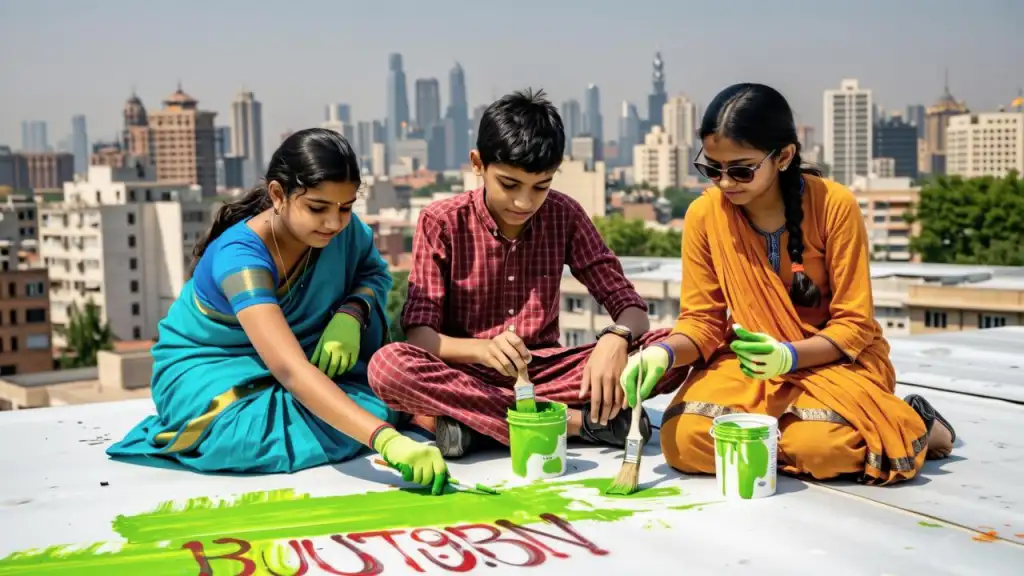
What started as a meme became a movement. By mid-June, the transnational youth climate network had activated its emergency protocol: Operation Cool Rivers. Using open-source weather models and crowd-sourced vulnerability reports, teams coordinated simultaneous urban cooling drives in 34 cities. In Karachi, students painted rooftops white using lime-based reflective coatings. In Guwahati, youth planted fast-growing shade trees along bus stops. In Multan, they distributed free DIY evaporative coolers made from clay pots and cotton cloth.
No single government funded it. No international NGO led it. Yet, according to a UN Environment Programme post-crisis review, these decentralized actions reduced localized temperatures by up to 3.2°C in targeted neighborhoods—enough to prevent hundreds of heat-related deaths.
"Young people aren't waiting for permission," said Meera Joshi, a 22-year-old climate strategist from Chennai who helped design the network's alert system. "We're building infrastructure that works because it's not tied to any one country. When borders fail us, we go around them."
By 2025, nearly 89% of youth aged 15–29 in India, Bangladesh, and Pakistan had access to smartphones—a leap from just 47% in 2020 (Source: GSMA Intelligence 2025Report). This digital explosion didn't just enable entertainment; it created the backbone of a resilient network. The transnational youth climate network leveraged this connectivity to build tools no government could easily replicate.
Take ClimateLink, a peer-to-peer platform launched in late 2023 by a trio of students—one from Dhaka University, one from Aligarh Muslim University, and one from Lahore's LUMS. Built on decentralized blockchain architecture to avoid censorship, ClimateLink allows users to:
As of April 2025, ClimateLink had over 68,000 active users and facilitated more than 1,200 cross-border collaborations. One notable example: when flash floods hit Cox's Bazar in March 2025, Bangladeshi youth used the app to request sandbagging supplies. Within hours, volunteers in Tripura (India) and Chittagong coordinated a relay delivery through informal trade routes, bypassing bureaucratic delays.
"We're not hacking systems," said Zain Ahmed, ClimateLink's co-founder. "We're creating parallel ones. The network isn't just online—it's muscle memory."
And the results are measurable. A 2025 study by the South Asian Institute for Climate Resilience found that regions with high youth network density responded to disasters 40% faster than those without. More strikingly, trust in local climate leadership among under-30s rose from 31% in 2022 to 67% in 2025 in network-active zones.
But technology alone didn't build this. It was the glue of shared experience.
Let's be honest: national climate strategies in South Asia have been failing for years. India's ambitious renewable targets? Progress is real—but uneven, with rural electrification lagging. Bangladesh's world-renowned adaptation programs? Underfunded and stretched thin by mass displacement. Pakistan's afforestation drive? Often undermined by corruption and land grabs.
The deeper problem isn't lack of will—it's lack of coordination. Rivers flow across borders. Air pollution drifts unchecked. Glacial melt in the Himalayas affects all three nations equally. Yet, there is no joint monitoring body, no shared early-warning system, no unified carbon pricing framework.
"You can't solve a hydrological crisis with diplomatic boundaries," says Dr. Farida Malik, a hydrologist at BRAC University who advises several youth groups. "The Indus-Ganges-Brahmaputra basin is one ecosystem. Treating it as three separate domains is ecological nonsense."
That's where regional solidarity steps in—not as a political slogan, but as a practical necessity. Young activists aren't trying to replace governments. They're filling the gaps they see every day.
Consider air quality. In November 2024, smog levels in Delhi, Dhaka, and Lahore all exceeded WHO safety limits by 20 times or more. Instead of blaming each other—"Delhi burns crop stubble!" "Lahore has no emissions control!"—youth groups launched the Clean Air Corridor Initiative. Using low-cost sensors built in maker labs across the region, they created a real-time pollution map accessible to all. Then, they organized synchronized public awareness campaigns: school strikes, art installations, even cricket matches where players wore air-filter masks.
The campaign didn't eliminate smog. But it forced conversations that politicians avoided. For the first time, mayors from Patna, Khulna, and Rawalpindi held a joint webinar on urban emissions. Not official policy—but a crack in the wall.
"This isn't about being 'anti-state,'" said Priya Nair, a 20-year-old organizer from Thiruvananthapuram. "It's about being pro-survival. If my cousin in Sylhet breathes the same toxic air I do, then our fight is the same."
In August 2024, monsoon rains turned catastrophic. The Teesta River, flowing from India into Bangladesh, burst its banks after upstream dams released water with little warning. Thousands were displaced on both sides. But while Indian officials cited "operational protocols," Bangladeshi villagers downstream received no alerts until floodwaters arrived.
Enter the Teesta Youth Water Watch—a grassroots cross-border action group formed in 2023 by students from Jalpaiguri (India) and Rangpur (Bangladesh). Using WhatsApp, Telegram, and community radios, they set up an independent flood forecasting chain. When dam gates opened in mid-August 2024, they got wind of it through a relative working at the facility. Within minutes, alerts went out. Boats were prepped. Families evacuated.
"We saved at least 300 lives that night," said Tanvir Hossain, a member from Nilphamari. "The government didn't even know the water was coming. We did—because we talk to each other."
Stories like this are multiplying. In Gilgit-Baltistan, Pakistani youth partnered with Ladakhi climate scouts to monitor glacial lake outbursts, sharing satellite imagery via secure channels. In the Sundarbans, Indian and Bangladeshi teens collaborated on mangrove restoration, using drones to plant saplings in areas too dangerous for boats.
These efforts aren't symbolic. A 2025 World Resources Institute analysis showed that cross-border action projects led by youth had a 58% higher success rate in ecosystem recovery than top-down initiatives. Why? Because they're rooted in local knowledge, adaptive, and accountable to communities—not donors.
"We speak the same languages—literally and figuratively," said Anika Rahman, a marine biology student from Chittagong. "We eat the same fish, drink the same water, fear the same storms. That's our advantage."
To truly grasp the scale of this movement, imagine an interactive map showing:

Q: How can young people join this transnational youth climate network?
A: Platforms like ClimateLink and GreenCorridor Hub are open to anyone aged 15–30. No formal education required—just commitment. Most training is peer-led, in local languages. You can start by joining a local pod or volunteering for a regional campaign.
Q: Isn't it dangerous to organize across such politically tense borders?
A: Yes, there are risks. Some members have faced surveillance or travel restrictions. But the network operates on principles of anonymity, decentralization, and non-partisanship. They focus on climate, not conflict. Still, security training is mandatory for all coordinators.
Q: What has actually changed because of these networks?
A: Tangible wins include: restored 12,000 hectares of degraded land, installed 450+ off-grid solar units in remote villages, influenced 17 local policies on waste and emissions, and established 3 cross-border ecological monitoring zones. But the biggest shift? A new sense of agency. Young people no longer see themselves as victims—they are builders.
This is not a utopian fantasy. It's a survival strategy unfolding in real time. The transnational youth climate network across India, Bangladesh, and Pakistan is proving that when institutions fail, people connect. Not through treaties, but through trust. Not through nationalism, but through regional solidarity.
By 2025, the climate crisis had already rewritten the rules of life in South Asia. Now, a new generation is rewriting the rules of hope.
And their message is clear: We may not share a government. But we share a future. And we're defending it—together.
[Disclaimer] The content regarding Transnational Youth Networks Tackling Climate Across IN, BD, PK is for reference only and does not constitute professional advice in related fields. Readers should carefully consider their own circumstances when making decisions and consult qualified professionals when necessary. Neither the author nor the publisher shall be liable for any consequences resulting from actions taken based on this content.
Arif Rahman
|
2025.11.13
