

 Feed back
 Privacy Policy
AquaStell
In January 2025, during a power blackout in Old Dhaka's Lalbagh neighborhood, an illegal basement gig went viral — not because of what was played, but because of what wasn't. For seven minutes, members of the collective Nodi Ondhokar (River Darkness) stood on stage without instruments, microphones off, eyes closed. The audience followed suit. No chants, no drums, no distortion pedals — just breathing in unison. When the lights flickered back, someone whispered into a dead mic: "We are still here." That silence, later sampled into a track called Breath Code Alpha, became one of the most potent symbols of protest music Bangladesh has produced this decade.
This wasn't noise. It was strategy. And it wasn't isolated. Across Bengal — stretching from West Bengal in India through Bangladesh to diasporic enclaves in Lahore and Karachi — a new wave of music is emerging that doesn't shout revolution so much as seep into it, like water through cracks. We're witnessing the rise of what scholars and artists alike are calling Aquarian soundscapes: fluid, adaptive, often liquid-textured compositions rooted in ecological metaphors and designed to evade state capture while sustaining communal resilience.
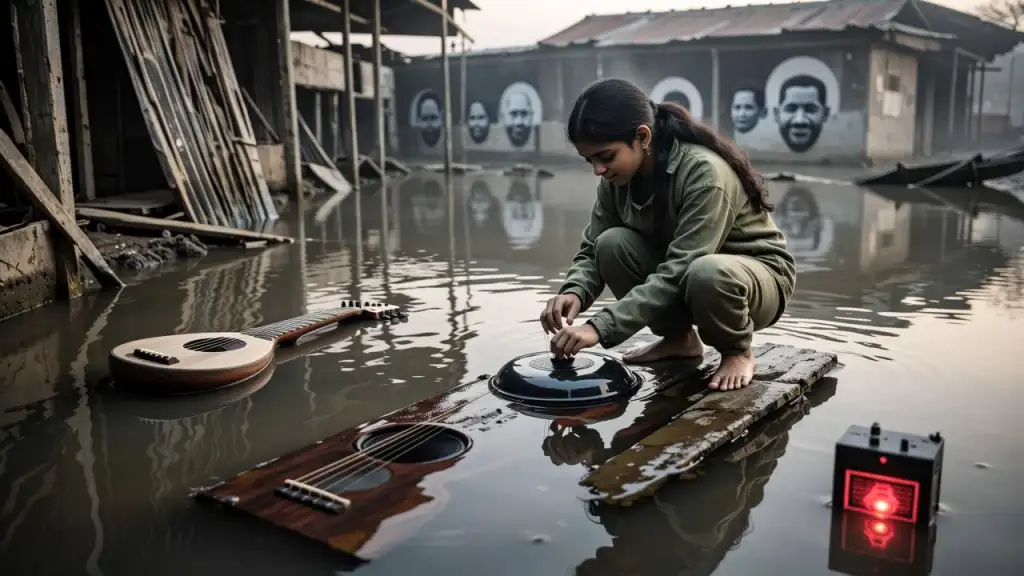
Let's return to that night. Police had shut down nearly every known venue hosting politically charged performances by early 2025. Surveillance drones scanned rooftops for gatherings larger than ten people. Streaming platforms censored tracks flagged for "subversive content" — sometimes before they were even released. So underground gigs moved deeper underground: basements, abandoned warehouses near the Buriganga River, even floating stages on houseboats anchored between unprotected riverbanks.
Nodi Ondhokar chose such a location. But minutes before their set, word came — informants had tipped off authorities. Instead of fleeing, they turned off all amplification. They performed silence.
"You can't arrest silence," says Tana Rahman, the group's lead vocalist and sound designer, speaking over encrypted audio in April 2025. "You can't copyright it. You can't algorithmically detect its sentiment. But everyone who was there remembers how it felt — like holding your breath underwater, waiting to surface."
To understand why water has become the central metaphor in contemporary Bengali resistance music, we must trace the lineage of political expression in the region.
At the turn of the 20th century, Rabindranath Tagore used classical ragas and poetic abstraction to critique colonial rule — his work banned repeatedly by British authorities. In 1971, during Bangladesh's Liberation War, artists like Sheikh Lutfar Rahman and the band Uccharon fused folk rhythms with revolutionary lyrics, broadcasting songs over clandestine radio stations. Fast forward to 2013, when student-led protests against war criminals saw thousands chanting "Ekattor er Chele, Abar Juddho Chai Na!" ("Son of '71, I Don't Want War Again!") — a melody adapted from traditional Baul tunes.
Each era shaped its own form of sonic rebellion. But 2025 presents unique challenges: hyper-digital monitoring, deepfake disinformation campaigns, and shrinking civic space. According to a 2024 report by Free Press Unlimited, Bangladesh ranked 162nd out of 180 countries in press freedom — and musicians faced increasing scrutiny under Section 57 of the Digital Security Act.
So how do you sing truth to power when singing itself is dangerous?
Imagine a language that speaks in ripples.
That's what's happening across the Bengali-speaking world. Poets write of rivers remembering names. DJs sample monsoon rains into four-on-the-floor beats. Rappers freestyle about being "born in a delta, raised by floods." Even traditional instruments like the dotara and ektara are being rewired with moisture-resistant circuits, allowing them to be played midstream.
But why water?
Because water is memory. Because water crosses borders. Because water cannot be owned.
Consider this: since 2020, over 1.2 million people have been displaced due to river erosion along the Padma and Jamuna rivers in Bangladesh (Source: Bangladesh Water Development Board 2023). Entire villages vanish overnight, swallowed by shifting currents. Official records often erase these communities — no census, no compensation, no history.
By 2025, repression had forced innovation.
Independent studios in Dhaka and Kolkata were raided. Hard drives seized. Musicians detained under vague charges of "inciting unrest." So, inspired by Cold War-era samizdat publishing, a network of decentralized creative hubs emerged — what insiders call shonobarik ashar ("sound shelters").
These aren't physical spaces so much as distributed systems.
An artist in Sylhet records a vocal line, encrypts it, and uploads it to a dormant blog post via Tor. A producer in Guwahati downloads it days later, adds a synth layer, and routes it to a collaborator in Lahore using blockchain-based audio ledgers. The final mix might premiere not online, but live — played once, recorded minimally, then deleted.

Some groups use AI voice cloning to protect identities. Others embed messages in spectrograms — images hidden within sound frequencies visible only when analyzed visually.
"We don't release albums anymore," says Zayan Malik, a Lahore-based experimental musician linked to several cross-border projects. "We release experiences. Events that exist briefly, like raindrops."
Aquarian soundscapes are experimental, water-inspired musical environments characterized by fluid structures, submerged textures, and themes of adaptation and memory. They prioritize mood over message, making them resilient to censorship.
Yes — but effectiveness now lies less in mass reach and more in deep, community-rooted impact. Songs function as codes, archives, and rituals rather than calls to action. Their power is in persistence, not virality.
Avoid sharing identifiable content publicly. Support through decentralized funding platforms like Gitcoin or ArtistCoin. Attend diaspora performances. Most importantly: listen deeply, and ask whom the music serves.
In 2025, music in Bengal is no longer just heard — it's lived. It flows through cracked pavements, rises with morning mist, echoes in the hollows of forgotten rivers. What began as protest music Bangladesh has transformed into something far more enduring: a sonic rebellion that doesn't resist extinction by standing firm — but by becoming liquid, elusive, eternal.
Disclaimer: The content provided in this article about protest music Bangladesh is for informational purposes only. The views expressed do not constitute professional advice. Readers should conduct their own research and consult experts before making decisions based on this content.
Nadia Rahman
|
2025.11.13
