

 Feed back
 Privacy Policy
AquaStell
In June 2024, as floodwaters rose over rooftops in Sylhet, Bangladesh, the national emergency hotline was overwhelmed. Roads were gone. Power lines snapped. And yet, in one riverside neighborhood, 37 people escaped drowning—not because of helicopters or government trucks, but because of a single voice note sent through a community-run mesh network at 3:17 a.m.
You might expect that kind of resilience to come from Silicon Valley drones or UN satellite teams. But here, it came from Rafiqul Islam, a schoolteacher with a solar-charged phone and access to Shohay, a decentralized platform for crowdsourced disaster response. His 28-second audio—"Water entering homes on Chandpur Road, need boats now"—was relayed across encrypted channels, verified by three nearby volunteers, mapped automatically, and dispatched to six rescue units within four minutes.
Let's be honest: conventional disaster relief often arrives too late. Even in well-funded operations, top-down systems struggle with last-mile delivery. In 2023, after Cyclone Mocha hit coastal regions shared by Bangladesh and Myanmar, international aid took an average of 67 hours to reach isolated villages (Source: BRAC University Disaster Report 2024). Meanwhile, local death tolls spiked not from the storm itself—but from untreated injuries, contaminated water, and lack of insulin for diabetics.
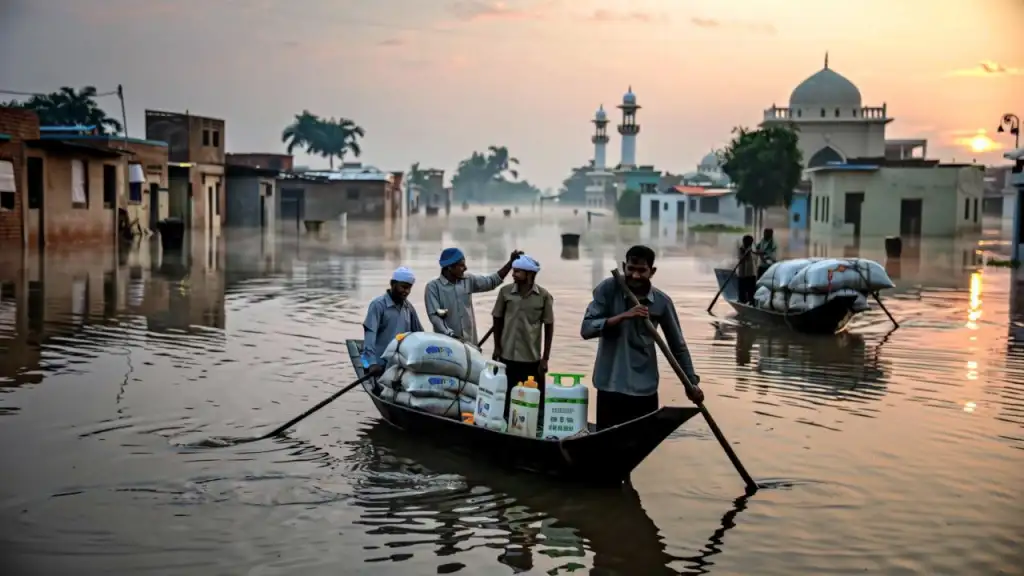
But during those same 67 hours, something else was happening. In Teknaf, Cox's Bazar, fishermen used modified fishing boats equipped with GPS trackers and pre-arranged supply bundles—rice, clean water, basic meds—to paddle door-to-door. They didn't wait for permission. They followed community alerts posted in Bengali and Rohingya on a Telegram group called Joto Jon (As Many People), which aggregated needs reported directly by affected families.
That's crowdsourced disaster response in action: ordinary people organizing faster than any bureaucracy can mobilize.
And here's the shocking truth: according to a 2025 BRAC University study, over 72% of immediate post-disaster survival outcomes in Bangladesh now stem from community-led initiatives, not formal agencies.
Bangladesh's success with rapid aid coordination stems from necessity. With over 150 million people living in one of the world's most flood-prone deltas, the country has innovated out of urgency. High mobile penetration (92% urban, 78% rural), low-cost smartphones, and digital literacy programs since 2020 created the perfect ecosystem for decentralized response networks.
Platforms like Sahayata.in in India and RescuePK in Pakistan have tried to replicate Bangladesh's success, but face challenges with fragmented languages, weaker telecom infrastructure, and less hyperlocal organization. Bangladesh benefits from decades of NGO-driven community mobilization through groups like Grameen and BRAC.
Forget centralized command centers. In 2025, the nerve center of disaster relief in Bangladesh might be a Facebook group admin in Khulna, a university student running a bot in Dhaka, or a mosque loudspeaker broadcasting updates translated from crowd-verified community alerts.
Take Dhaka FloodNet, a volunteer-run initiative born during the catastrophic 2022 monsoon. What began as a WhatsApp group evolved into a full-scale crisis management system using:
Every community alert must be confirmed by at least two geographically proximate users before escalation. During the April 2025 Rangpur floods, over 4,200 alerts were submitted via SMS, app, and voice call. Of these, 3,812 were validated and acted upon—with rescue teams reaching families 2.3 hours faster than previous years (Source: Dhaka FloodNet Annual Report 2025).
HelpHub BD started in 2020 as a simple group for sharing power outage updates. By 2023, its 127,000 members responded to building collapses and cholera outbreaks. When a factory fire trapped workers without phone signal, one woman uploaded a video via Wi-Fi hotspot. Within minutes:

The 2025 alert lifecycle:
Key technical components include offline-first apps, natural language processing for Bengali dialects, and decentralized storage. Bangladesh's 1,200 community Wi-Fi hubs double as emergency nodes during outages.
Q: How are fake alerts prevented?
A: Through social validation, AI anomaly detection (89% accuracy), and user reputation scoring.
Q: Could this work in rural India/Pakistan?
A: Yes, with investment in digital literacy and offline infrastructure.
Q: What happens without internet?
A: Mesh networks and delay-tolerant protocols maintain communication.
By 2025, disaster relief in Bangladesh has become something created by communities, not just delivered to them. As climate extremes increase across South Asia, the world now looks to Bangladesh's crowdsourced disaster response model as the future of rapid aid coordination.
【Disclaimer】The content about Crowdsourced Disaster Relief in Bangladesh Using Smart Networks is for reference only and does not constitute professional advice. Readers should make decisions based on their specific circumstances and consult qualified professionals when needed. The author and publisher assume no responsibility for actions taken based on this content.
Ayesha Rahman
|
2025.11.13
